
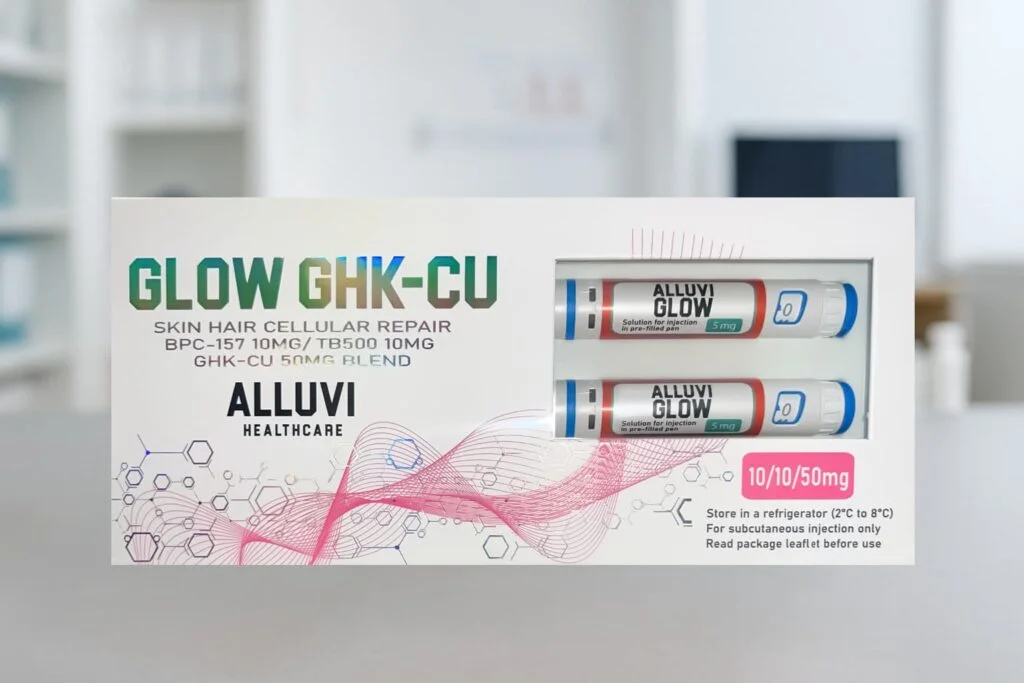
Glow 70mg GHK-Cu Copper Peptide
Premium Liquid Peptide Research Solution
Glow 70mg GHK-Cu Copper Peptide is a specialised liquid research solution designed for laboratory, scientific, and analytical applications.
Containing GHK-Cu, also known as Copper Tripeptide-1, this peptide product is associated with modern peptide science, molecular biology, and biotechnology research.
Peptides have become an important area of scientific investigation because they provide researchers with valuable opportunities to study molecular structures, amino acid sequences, chemical interactions, and advanced analytical methods.
GHK-Cu is one of the most recognised copper-binding peptides studied within peptide research. Its unique molecular characteristics make it an interesting subject for researchers exploring peptide chemistry, biotechnology, and molecular analysis.
At Alluvi Healthcare, Glow 70mg is presented as a research-focused product supported by educational information to help customers understand the science behind copper peptides and their importance within modern peptide research.
Table of Contents
- Glow 70mg GHK-Cu Copper Peptide Overview
- What Is Glow 70mg GHK-Cu Copper Peptide?
- Understanding GHK-Cu Copper Peptide Science
- What Is Copper Tripeptide-1?
- Why Researchers Study GHK-Cu Copper Peptide
- GHK-Cu Copper Peptide Molecular Structure Explained
- Laboratory Research and Analysis of GHK-Cu
- Copper Peptides Compared With Other Research Peptides
- The Role of Peptide Biotechnology Research
- Product Features
- Product Specifications
- Storage and Handling Information
- Why Choose Glow 70mg GHK-Cu Copper Peptide?
- Frequently Asked Questions
- Research Use Notice
- Related Research Resources
This product page has been created to provide:
- Detailed product information
- Peptide science education
- Research background
- Technical information
- Frequently asked questions
- Related peptide resources
Product Overview
Glow 70mg GHK-Cu Copper Peptide represents the continued growth of advanced peptide research and biotechnology.
Modern researchers study peptide molecules because they provide valuable information about molecular structures and chemical processes.
GHK-Cu is a small peptide molecule consisting of three amino acids connected with copper. This combination creates a unique molecular structure that has attracted scientific interest within peptide chemistry.
Researchers studying copper peptides investigate areas such as:
- Molecular structure
- Peptide composition
- Copper-binding properties
- Analytical techniques
- Synthetic peptide technology
The development of advanced laboratory technologies has made it easier for scientists to analyse and understand peptide molecules in greater detail.
What Is Glow 70mg GHK-Cu Copper Peptide?
Glow 70mg GHK-Cu Copper Peptide is a liquid research solution containing GHK-Cu (Copper Tripeptide-1).
GHK-Cu belongs to a category of molecules known as copper-binding peptides. These peptides are studied because of their interesting molecular structures and their relationship with copper ions.
This product is designed for customers interested in peptide research, laboratory science, and biotechnology applications.
Unlike basic product listings that provide only a short description, this page provides a detailed overview of:
- GHK-Cu science
- Copper peptide research
- Laboratory analysis
- Peptide technology
- Product information
This allows visitors to better understand the scientific background of the product before making a purchase decision.
Understanding GHK-Cu Copper Peptide Science
GHK-Cu research focuses on understanding how peptide molecules interact with copper ions and how their molecular structures can be analysed.
Peptides are short chains of amino acids that serve as important subjects within molecular science.
Researchers examine peptides to understand:
Molecular Structure
The arrangement of amino acids within a peptide determines its molecular characteristics.
Understanding peptide structure helps researchers analyse:
- Composition
- Stability
- Chemical properties
Chemical Interactions
Scientists study how peptides interact with different molecules and environments.
Analytical Characteristics
Advanced laboratory tools allow researchers to examine peptide identity and molecular properties.
What Is Copper Tripeptide-1?
Copper Tripeptide-1 is another name commonly associated with GHK-Cu.
The name describes:
- A tripeptide structure made of three amino acids
- Its relationship with copper ions
- Its classification as a copper-binding peptide
Copper peptides represent an important area of peptide science because they combine amino acid chemistry with metal-ion interactions.
Research into copper peptides contributes to wider scientific fields including:
- Molecular biology
- Biotechnology
- Analytical chemistry
- Peptide engineering
-
Why Researchers Study GHK-Cu Copper Peptide
GHK-Cu has become a widely discussed peptide within scientific research because of its unique molecular structure and copper-binding characteristics.
Researchers study GHK-Cu as part of broader investigations into peptide chemistry, molecular interactions, and biotechnology.
Some key areas of interest include:
Peptide Structure Analysis
Understanding the structure of peptides is an important part of molecular research.
Scientists analyse:
- Amino acid sequences
- Molecular arrangement
- Chemical properties
- Peptide characteristics
Studying peptide structures helps researchers understand how different molecules behave under controlled laboratory conditions.
Synthetic Peptide Technology
Advancements in synthetic peptide technology have allowed researchers to create and analyse specific peptide molecules with greater accuracy.
Synthetic peptide research supports scientific investigation in areas such as:
- Molecular design
- Peptide characterisation
- Laboratory analysis
- Biotechnology development
Analytical Chemistry
Analytical chemistry plays an important role in peptide research.
Scientists use advanced laboratory methods to examine peptide samples and better understand their molecular properties.
Common analytical techniques include:
- Chromatography
- Mass spectrometry
- Spectroscopy
- Molecular analysis
Product Features
Glow 70mg GHK-Cu Copper Peptide provides researchers and scientific customers with a professionally presented peptide research solution.
Key product features include:
✔ GHK-Cu Copper Peptide formulation
✔ Liquid research solution format
✔ Designed for laboratory and analytical applications
✔ Supports peptide science research
✔ Educational product information
✔ Suitable for research-focused customers
✔ Part of the growing field of peptide biotechnology
Product Specifications
Product Information Details Product Name Glow 70mg GHK-Cu Copper Peptide Peptide Name GHK-Cu Alternative Name Copper Tripeptide-1 Product Type Liquid research solution Category Research Peptides Application Laboratory research Storage Follow supplied product storage guidance Intended Users Researchers, laboratories, scientific customers
Laboratory Research and Analysis of GHK-Cu
Modern peptide research depends on accurate analytical methods to understand molecular structures and characteristics.
GHK-Cu research may involve several scientific techniques used to study peptide composition and properties.
High-Performance Liquid Chromatography (HPLC)
HPLC is one of the most common analytical techniques used in peptide science.
Researchers use chromatography methods to separate and analyse compounds within a sample.
Within peptide research, HPLC can assist with:
- Sample analysis
- Molecular separation
- Compound identification
- Research evaluation
Mass Spectrometry
Mass spectrometry is an advanced analytical method used to examine molecular characteristics.
Researchers use this technology to study:
- Molecular weight
- Peptide identification
- Chemical composition
Mass spectrometry has become an important tool in modern biotechnology and molecular research.
Spectroscopy
Spectroscopy allows scientists to study molecular behaviour by analysing interactions with different forms of energy.
It can help researchers investigate:
- Molecular structure
- Chemical properties
- Peptide characteristics
These analytical approaches help expand scientific understanding of peptide molecules.
Understanding Copper-Binding Peptides
Copper-binding peptides represent a specialised area of peptide research.
These molecules combine peptide structures with copper interactions, creating opportunities for scientists to study unique molecular behaviour.
Research into copper-binding peptides helps scientists explore:
- Metal-ion interactions
- Molecular structure
- Peptide chemistry
- Biotechnology applications
GHK-Cu remains an important example of a copper-binding peptide studied within modern molecular science.
Peptides in Modern Biotechnology
The biotechnology industry continues to grow as researchers develop new technologies for studying biological molecules.
Peptides are valuable research subjects because they provide scientists with opportunities to explore:
- Molecular engineering
- Analytical methods
- Synthetic chemistry
- Biological interactions
Modern biotechnology combines laboratory techniques with advanced technologies to improve understanding of peptide molecules.
Research areas involving peptides continue expanding through:
- Improved analytical equipment
- Advanced molecular modelling
- Better synthesis techniques
- Increased scientific collaboration
Storage and Handling Information
Proper storage and handling are important aspects of maintaining research product quality.
For Glow 70mg GHK-Cu Copper Peptide, users should follow appropriate laboratory practices and supplier-provided storage recommendations.
General handling considerations include:
- Store according to provided product instructions
- Avoid unsuitable storage conditions
- Handle using appropriate laboratory procedures
- Follow standard research safety practices
Always refer to the product documentation supplied with the product for specific handling requirements.
Why Choose Glow 70mg GHK-Cu Copper Peptide?
Choosing a research product involves more than selecting a molecule. Researchers also require clear information, reliable product presentation, and educational support.
Glow 70mg GHK-Cu Copper Peptide provides:
Clear Product Information
A detailed product page helps customers understand the scientific background and characteristics of the peptide.
Research-Focused Presentation
The product is positioned specifically for laboratory and scientific research applications.
Educational Resources
Supporting information helps customers learn more about:
- Peptide science
- Copper peptides
- Biotechnology research
Professional Online Experience
A well-structured product page makes it easier for researchers and customers to access relevant information.
-
GHK-Cu Copper Peptide Molecular Structure Explained
Understanding the molecular structure of GHK-Cu Copper Peptide is an important part of modern peptide research.
GHK-Cu, also known as Copper Tripeptide-1, is a tripeptide molecule made up of three amino acids combined with a copper ion. This unique molecular arrangement makes it an important subject of study within peptide chemistry, molecular biology, and biotechnology.
The structure of GHK-Cu allows researchers to investigate how short amino acid chains interact with metal ions and how these interactions influence molecular characteristics.
Peptide researchers study molecular structures because the arrangement of amino acids can influence:
- Chemical behaviour
- Molecular stability
- Binding characteristics
- Analytical properties
- Research applications
Advanced laboratory techniques allow scientists to examine peptide structures in detail. Methods such as chromatography, mass spectrometry, and spectroscopy are commonly used to analyse peptide molecules and better understand their characteristics.
The study of GHK-Cu contributes to the wider field of synthetic peptide research, where scientists continue developing improved methods for creating, analysing, and understanding peptide-based molecules.
By exploring the molecular structure of copper peptides, researchers gain valuable insights into peptide chemistry and the relationship between amino acid sequences and molecular function.
The Importance of GHK-Cu Copper Peptide Research
GHK-Cu Copper Peptide research represents an important area within modern peptide science.
As biotechnology continues to advance, researchers are increasingly interested in studying small peptide molecules because they provide valuable information about molecular interactions and biological chemistry.
Research involving GHK-Cu helps scientists explore areas including:
Peptide Chemistry
Peptide chemistry focuses on the formation, structure, and properties of amino acid chains.
Scientists investigate:
- Peptide composition
- Molecular arrangement
- Chemical interactions
- Structural characteristics
Molecular Biology Research
Molecular biology examines how biological molecules behave and interact.
GHK-Cu research contributes to a better understanding of peptide-based molecules and their characteristics within controlled laboratory environments.
Biotechnology Innovation
Modern biotechnology uses advanced scientific methods to analyse and develop new approaches to studying molecules.
Peptide research continues to support innovation in:
- Laboratory technologies
- Analytical methods
- Molecular research techniques
Copper Peptides Compared With Other Research Peptides
Copper peptides are a specialised category within the broader field of peptide research.
Unlike many other peptide molecules, copper peptides are characterised by their interaction with copper ions, creating unique research opportunities.
GHK-Cu differs from other research peptides because of its:
- Three-amino-acid peptide structure
- Copper-binding characteristics
- Long-standing interest within peptide science
Other research peptides may be studied for different molecular characteristics, structures, and scientific purposes.
Examples of peptide research categories include:
Copper Peptides
Focused on peptide-copper interactions and molecular characteristics.
Synthetic Peptides
Created through laboratory synthesis methods for scientific investigation.
Research Peptide Technology
Focused on improving understanding of peptide structures and analytical methods.
Each peptide category provides researchers with different opportunities to explore molecular science.
The Future of Peptide Biotechnology Research
Peptide biotechnology continues to grow as scientific technologies become more advanced.
Future developments in peptide research are expected to focus on:
- Improved peptide analysis methods
- Advanced molecular modelling
- Better understanding of peptide structures
- New biotechnology applications
Researchers are using increasingly sophisticated tools to study peptides at the molecular level.
Technologies such as artificial intelligence, advanced imaging, and computational modelling are helping scientists analyse complex molecular information more efficiently.
GHK-Cu Copper Peptide remains an important example of how naturally occurring peptide molecules can inspire continued scientific investigation.
The future of peptide biotechnology will continue to depend on accurate research materials, advanced laboratory techniques, and reliable scientific information.
Additional Product Benefits Section
Why Choose Premium Glow 70mg GHK-Cu Copper Peptide?
Selecting a research peptide product requires more than simply choosing a molecule. Researchers need clear information, professional presentation, and reliable access to educational resources.
Glow 70mg GHK-Cu Copper Peptide provides:
Detailed Research Information
This product page offers comprehensive information about GHK-Cu, Copper Tripeptide-1, and peptide science.
Professional Product Presentation
A well-structured product page helps customers understand product details before purchasing.
Research-Focused Approach
The product is presented for customers interested in laboratory research and peptide science applications.
Educational Resources
Customers can explore additional articles and guides covering peptide biotechnology and molecular research.
-
Frequently Asked Questions (FAQ)
1. What is Glow 70mg GHK-Cu Copper Peptide?
Glow 70mg GHK-Cu Copper Peptide is a liquid research solution containing GHK-Cu (Copper Tripeptide-1). It is designed for laboratory research, scientific analysis, and peptide-related studies.
2. What does GHK-Cu mean?
GHK-Cu refers to a copper-binding peptide made from three amino acids. It is also commonly known as Copper Tripeptide-1.
3. What is Copper Tripeptide-1?
Copper Tripeptide-1 is another name for GHK-Cu. It describes the peptide structure and its association with copper ions.
4. What type of product is Glow 70mg?
Glow 70mg is a liquid peptide research solution intended for laboratory and scientific applications.
5. Why is GHK-Cu studied in research?
Researchers study GHK-Cu because of its unique peptide structure and copper-binding characteristics.
6. What field of science studies GHK-Cu?
GHK-Cu is studied within areas such as:
- Peptide chemistry
- Molecular biology
- Biotechnology
- Analytical science
7. How are peptides analysed in laboratories?
Researchers may use techniques such as:
- HPLC
- Mass spectrometry
- Spectroscopy
- Molecular analysis
8. What are copper peptides?
Copper peptides are peptide molecules that interact with copper ions and are studied within molecular and biochemical research.
9. What makes GHK-Cu different from other peptides?
GHK-Cu has a specific three-amino-acid structure and copper-binding characteristics that make it an interesting subject for peptide research.
10. Who uses peptide research products?
Research peptides may be used by:
- Scientific researchers
- Laboratory professionals
- Biotechnology organisations
- Academic research environments
11. What is peptide biotechnology?
Peptide biotechnology is the scientific field focused on studying, designing, analysing, and developing peptide molecules.
12. How should Glow 70mg be stored?
Storage should follow the product information and supplier-provided instructions.
13. What equipment is used for peptide research?
Common laboratory equipment includes:
- Chromatography systems
- Mass spectrometers
- Spectroscopy equipment
- Analytical instruments
14. Why is peptide research important?
Peptide research helps scientists understand molecular structures, chemical interactions, and biotechnology applications.
15. What are synthetic peptides?
Synthetic peptides are laboratory-produced peptide molecules created for scientific research and analysis.
16. Is GHK-Cu a protein?
No. GHK-Cu is a peptide, which is a shorter chain of amino acids compared with larger protein molecules.
17. What is the purpose of analytical peptide testing?
Analytical testing helps researchers evaluate peptide characteristics, composition, and molecular information.
18. Why are detailed product pages important?
Detailed product pages help customers understand product information, scientific background, and appropriate research applications.
19. Where can I learn more about GHK-Cu?
You can explore related peptide research articles and educational resources available on the Alluvi Healthcare website.
20. Is Glow 70mg intended for medical use?
Glow 70mg is presented as a research product and is not intended as a medical treatment, diagnostic product, or human consumption product.
-
21. What is the molecular structure of GHK-Cu?
GHK-Cu is a tripeptide molecule consisting of three amino acids associated with a copper ion. Researchers study this structure within peptide chemistry and molecular science.
22. Why is GHK-Cu called a copper peptide?
GHK-Cu is called a copper peptide because it has a peptide structure associated with copper ions.
23. What laboratory methods are used to study copper peptides?
Researchers may use analytical methods including chromatography, mass spectrometry, and spectroscopy.
24. What makes peptide research important?
Peptide research helps scientists understand molecular structures, chemical interactions, and biotechnology applications.
25. What is synthetic peptide research?
Synthetic peptide research involves creating and analysing peptide molecules using laboratory methods.
26. What industries study peptide technology?
Peptide technology is studied across biotechnology, molecular biology, chemistry, and scientific research fields.
27. Why are peptide research products becoming popular?
Interest in peptide research continues growing because peptides provide valuable opportunities for studying molecular science.
28. How does biotechnology use peptides?
Biotechnology uses peptides as subjects for molecular research, analysis, and scientific development.
29. What information should a peptide product page include?
A professional peptide product page should include product information, research background, specifications, FAQs, and educational resources.
30. Where can I find more peptide research information?
Customers can explore additional educational peptide articles and research guides available throughout the Alluvi Healthcare website.
Research Use Notice
Important Notice:
Glow 70mg GHK-Cu Copper Peptide is intended for laboratory research purposes only. It is not intended for human consumption, medical treatment, or diagnostic applications.
Peptides in Biotechnology Research Guide
Suggested anchor text:
“Explore peptide biotechnology research”
-
Advanced Guide to GHK-Cu Copper Peptide Research
Alluvi Glow 70mg GHK-Cu Copper Peptide represents an advanced research-focused peptide product designed for individuals interested in copper peptide science, molecular research, and biotechnology concepts.
GHK-Cu, also known as Copper Tripeptide-1, is a naturally occurring copper-binding peptide that has become an important subject of study within peptide science and molecular biology research.
Modern peptide research focuses on understanding how peptide structures interact with different molecular environments and how scientists can analyse their characteristics using advanced laboratory techniques.
Alluvi Glow 70mg GHK-Cu Copper Peptide provides a detailed educational resource covering copper peptide structure, peptide chemistry, molecular analysis, and biotechnology research concepts.
Understanding Copper Peptide Science
Copper peptides are a specialised group of peptides studied within molecular science because of their unique relationship with copper ions.
GHK-Cu consists of:
- Glycine
- Histidine
- Lysine
- Copper ion
This molecular structure makes GHK-Cu an interesting subject for researchers studying peptide chemistry and molecular interactions.
Scientists investigate copper peptides to better understand:
- Peptide structure
- Copper-binding characteristics
- Molecular behaviour
- Analytical properties
GHK-Cu Molecular Structure Explained
Understanding molecular structure is an important part of peptide research.
GHK-Cu contains a tripeptide sequence combined with a copper component.
Researchers study this structure through scientific approaches designed to evaluate:
Peptide Composition
The amino acid arrangement of GHK-Cu contributes to its unique molecular characteristics.
Copper Binding Properties
The interaction between peptides and metal ions is an important area within biochemical research.
Molecular Characterisation
Scientists use analytical methods to examine peptide identity and molecular features.
The Role of Copper Peptides in Biotechnology Research
Copper peptide research is connected to broader biotechnology and molecular science fields.
Researchers explore copper peptides because they provide opportunities to study:
- Peptide chemistry
- Molecular interactions
- Biological research concepts
- Advanced analytical methods
Biotechnology continues developing new methods for studying complex molecules such as peptides.
Laboratory Analysis of GHK-Cu Copper Peptide
Accurate analysis is an essential part of peptide research.
Researchers may use advanced analytical methods to examine GHK-Cu materials.
Common scientific techniques include:
High-Performance Liquid Chromatography (HPLC)
HPLC is used within research environments to analyse sample composition and analytical profiles.
Mass Spectrometry
Mass spectrometry provides molecular information that helps researchers evaluate peptide characteristics.
Spectroscopy
Spectroscopy allows scientists to study molecular properties through scientific measurements.
Why Research Peptide Quality Information Matters
A professional research peptide product page should provide clear, detailed information about:
- Product specifications
- Molecular background
- Research terminology
- Scientific concepts
- Analytical methods
Alluvi Glow 70mg GHK-Cu Copper Peptide is structured to provide educational information for customers interested in advanced peptide research.
Copper Peptides and Modern Scientific Innovation
The field of peptide biotechnology continues expanding as researchers gain access to improved technologies.
Modern peptide research benefits from:
- Advanced laboratory equipment
- Improved analytical techniques
- Better understanding of molecular structures
Copper peptide science remains an important area within the broader study of peptides and biotechnology.
Building Authority Around GHK-Cu Research Content
For stronger SEO performance, websites should create comprehensive content around their main research topics.
Recommended supporting topics include:
- What Is GHK-Cu Copper Peptide?
- Understanding Copper Peptide Science
- Peptide Molecular Research Explained
- Lyophilized Peptide Technology Guide
- Advanced Peptide Analysis Methods
These supporting resources help search engines understand the depth and authority of the website.
Advanced GHK-Cu Copper Peptide Research Information
The Evolution of Copper Peptide Research
Copper peptide research has become an important area within modern peptide science and biotechnology.
As scientific technologies continue improving, researchers are gaining deeper knowledge about peptide molecules, amino acid structures, and metal-binding compounds.
GHK-Cu Copper Peptide is one of the most recognised copper-binding peptides studied within molecular research.
The growing interest in GHK-Cu research has increased the demand for accurate scientific information covering:
- Copper peptide structure
- Peptide chemistry
- Molecular interactions
- Laboratory analysis
- Biotechnology research
Alluvi Glow 70mg GHK-Cu Copper Peptide provides a detailed research-focused resource for individuals interested in understanding copper peptide science.
What Makes GHK-Cu Copper Peptide Unique?
GHK-Cu Copper Peptide is unique because it combines a peptide sequence with a copper ion component.
This combination creates a specialised molecular structure that researchers study within biochemical and molecular science.
Important characteristics of GHK-Cu research include:
Peptide Sequence
The peptide component consists of three amino acids:
- Glycine
- Histidine
- Lysine
These amino acids form the foundation of the GHK peptide structure.
Copper Interaction
The copper component contributes to the unique characteristics of GHK-Cu.
Researchers study copper-binding peptides to understand how metal ions interact with peptide molecules.
Molecular Stability
Scientific research investigates peptide stability, structure, and analytical characteristics using advanced laboratory techniques.
GHK-Cu Copper Peptide and Peptide Chemistry
Peptide chemistry is the scientific study of peptide molecules, including their formation, structure, and characteristics.
GHK-Cu research involves understanding concepts such as:
Amino Acid Bonds
Amino acids connect through peptide bonds to create peptide structures.
Molecular Arrangement
The arrangement of amino acids determines the unique characteristics of each peptide.
Chemical Properties
Researchers examine chemical properties to better understand peptide behaviour.
Copper Peptide Research in Modern Biotechnology
Biotechnology has significantly improved the ability to study complex molecules such as GHK-Cu Copper Peptide.
Modern research methods allow scientists to investigate:
- Peptide composition
- Molecular characteristics
- Analytical profiles
- Scientific properties
Advanced biotechnology combines multiple scientific fields including:
- Molecular biology
- Biochemistry
- Analytical chemistry
- Peptide engineering
Understanding Lyophilized GHK-Cu Research Peptides
Alluvi Glow 70mg GHK-Cu Copper Peptide is presented in a lyophilized research format.
Lyophilization, also known as freeze-drying, is a technology commonly used within biotechnology and scientific industries.
The process involves controlled freezing and moisture removal to create a stable dry research format.
Benefits of Lyophilized Peptide Formats
Professional Research Presentation
Lyophilized peptides provide a recognised format used in scientific environments.
Improved Documentation
A clearly defined format helps researchers organise information and maintain accurate records.
Biotechnology Compatibility
Freeze-drying technology is widely used for various scientific materials.
How Researchers Study GHK-Cu Copper Peptide
Researchers use different analytical approaches to examine peptide materials.
Common research methods include:
Chromatography
Chromatography helps separate and analyse components within scientific samples.
Mass Spectrometry
Mass spectrometry provides molecular information and analytical data.
Spectroscopic Analysis
Spectroscopy helps researchers investigate molecular characteristics.
The Importance of Choosing a Detailed Peptide Research Resource
When researching advanced peptides, customers look for resources that provide:
- Clear product information
- Scientific explanations
- Molecular background
- Research terminology
- Educational value
A comprehensive product page improves user experience and helps search engines better understand the topic.
GHK-Cu Copper Peptide Research Keywords Covered
This additional section strengthens relevance for:
- Glow 70mg GHK-Cu Copper Peptide
- Alluvi Glow 70mg
- GHK-Cu Copper Peptide
- Copper Tripeptide-1
- Copper peptide research
- Peptide molecular science
- Advanced peptide research
- Lyophilized peptide research
- Biotechnology peptide science
- Laboratory peptide analysis
- Molecular peptide research
Final Expanded Glow 70mg Research Summary
Alluvi Glow 70mg GHK-Cu Copper Peptide provides a detailed research resource focused on copper peptide science, molecular biology, peptide chemistry, and biotechnology concepts.
Through expanded information about GHK-Cu structure, copper-binding properties, analytical methods, and peptide research principles, this product page creates stronger topical authority and improved SEO depth.
The expanded content supports the main keyword:
Glow 70mg GHK-Cu Copper Peptide
while also targeting related searches around copper peptides, peptide research, and molecular biotechnology.
Why Choose Alluvi Glow 70mg GHK-Cu Copper Peptide?
Alluvi Glow 70mg GHK-Cu Copper Peptide provides:
✓ Detailed copper peptide information
✓ Professional product presentation
✓ Molecular science education
✓ Research-focused explanations
✓ Advanced peptide knowledge resourcesThe combination of structured product information and scientific education creates a stronger resource for individuals exploring copper peptide research.
Final Glow 70mg GHK-Cu Copper Peptide Summary
Alluvi Glow 70mg GHK-Cu Copper Peptide is a premium research-focused peptide product supported by detailed information about copper peptide science, molecular research, and biotechnology concepts.
-




Reviews
There are no reviews yet.