
Table of Contents
ToggleGHK-Cu Copper Peptide Research: The Complete Scientific Guide to Copper Tripeptide-1 and Advanced Peptide Science
Table of Contents
- Introduction to GHK-Cu Copper Peptide Research
- What Is GHK-Cu?
- Understanding Copper Peptides
- The Discovery of GHK-Cu
- Molecular Structure of GHK-Cu
- Why GHK-Cu Copper Peptide Research Is Important
- Cellular Signaling and Peptide Science
- Research Applications
- Frequently Asked Questions
- Conclusion
Introduction to GHK-Cu Copper Peptide Research
GHK-Cu copper peptide research has become one of the most important areas of study in modern peptide science. As biotechnology continues to evolve, researchers are increasingly investigating GHK-Cu, also known as Copper Tripeptide-1, to better understand its molecular characteristics, copper-binding properties, and role in biological systems.
Peptides are short chains of amino acids that act as signaling molecules throughout living organisms. Within laboratory environments, research peptides help scientists investigate cellular communication, protein interactions, and molecular biology. Among these compounds, GHK-Cu has received considerable attention because it naturally binds copper, an essential trace element involved in numerous biological processes.
Interest in GHK-Cu copper peptide research extends across multiple scientific disciplines, including biotechnology, molecular biology, cosmetic science, and cellular signaling research. Laboratories continue to explore how copper peptides interact with biological pathways and how peptide chemistry contributes to a deeper understanding of molecular mechanisms.
This guide provides a comprehensive introduction to GHK-Cu copper peptide research, explains the science behind Copper Tripeptide-1, and discusses why it remains one of the most studied copper peptides in modern laboratory research.
Research Use Only: GHK-Cu and other research peptides discussed in this article are intended solely for laboratory research. They are not approved for human consumption, diagnosis, treatment, or prevention of disease.
What Is GHK-Cu?
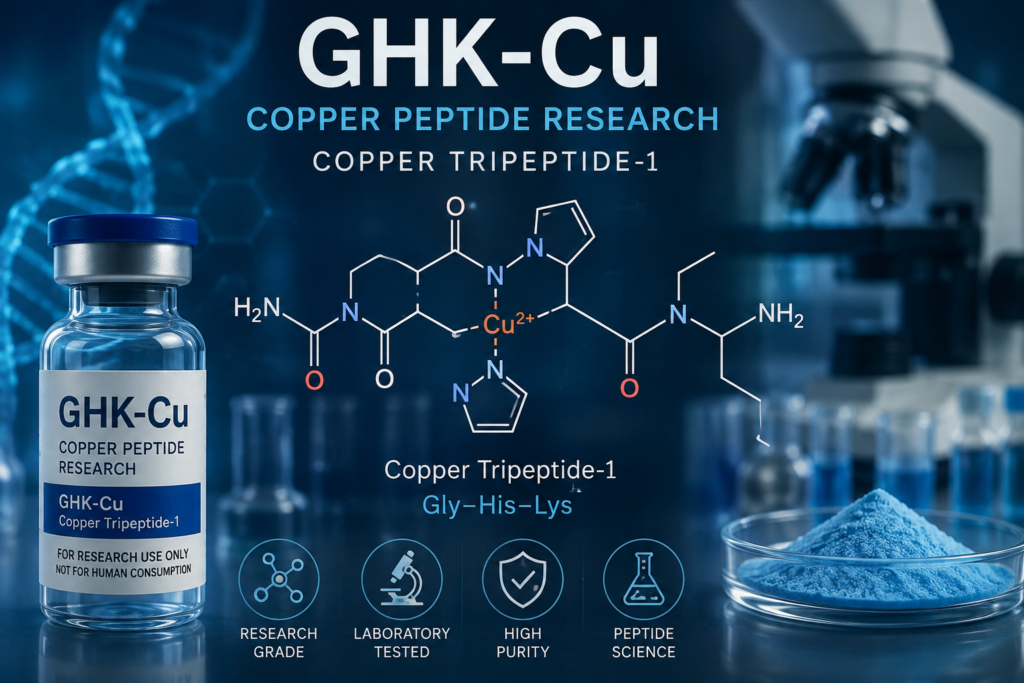
GHK-Cu, commonly known as Copper Tripeptide-1, is a naturally occurring peptide composed of three amino acids:
- Glycine
- Histidine
- Lysine
When these amino acids bind with a copper ion, they form the copper peptide complex known as GHK-Cu.
Researchers are interested in GHK-Cu copper peptide research because this peptide naturally occurs in the human body and demonstrates unique copper-binding properties that make it valuable for scientific investigation.
Within laboratory settings, GHK-Cu research focuses on understanding:
- Peptide chemistry
- Molecular biology
- Cellular communication
- Protein interactions
- Copper-binding mechanisms
- Biological signaling pathways
As one of the most recognized research peptides, GHK-Cu continues to play an important role in peptide science.
Understanding Copper Peptides
Copper peptides are molecules capable of binding copper ions. Copper is an essential mineral involved in many biological processes, making copper-binding peptides valuable tools for laboratory research.
Scientists investigate copper peptide research to better understand:
- Copper transport
- Molecular signaling
- Enzyme activity
- Cellular communication
- Protein interactions
- Biological regulation
Among the different copper peptides studied today, GHK-Cu Copper Tripeptide-1 remains one of the best-known compounds because of its naturally occurring structure and extensive research history.
The Discovery of GHK-Cu
The history of GHK-Cu copper peptide research began when scientists identified the peptide in human plasma. Researchers observed that GHK could bind copper ions efficiently, leading to increased interest in its biological properties.
Over time, additional studies expanded scientific knowledge of Copper Tripeptide-1, encouraging further research into:
- Peptide signaling
- Molecular pathways
- Protein interactions
- Cellular biology
- Biotechnology applications
Today, GHK-Cu research peptide studies continue in laboratories worldwide.
Molecular Structure of GHK-Cu
Understanding the molecular structure of GHK-Cu helps researchers appreciate why this peptide has become such an important scientific tool.
The peptide consists of:
Glycine – Histidine – Lysine
These three amino acids form a tripeptide capable of binding a copper ion.
Researchers investigate how this structure influences:
- Molecular stability
- Copper binding
- Protein interactions
- Biological communication
- Cellular responses
Because peptide structure influences biological activity, molecular analysis remains an essential component of GHK-Cu copper peptide research.
Why GHK-Cu Copper Peptide Research Matters
Modern biotechnology relies on understanding how molecules communicate within biological systems.
GHK-Cu copper peptide research contributes to this understanding by providing opportunities to investigate:
Cellular Signaling
Cells communicate using signaling molecules that regulate biological processes. Researchers study how peptides participate in these communication networks.
Molecular Biology
Peptides provide researchers with tools to investigate molecular pathways and protein interactions.
Biotechnology Innovation
Advances in peptide science contribute to biotechnology by expanding knowledge of molecular mechanisms and laboratory research methods.
Copper Biology
Copper is involved in numerous biological functions. Understanding how peptides bind copper helps scientists investigate metal-peptide interactions.
Cellular Signaling and Peptide Science
One of the most important aspects of GHK-Cu copper peptide research involves cellular signaling.
Cells constantly exchange information using proteins, peptides, and other signaling molecules. Researchers investigate how Copper Tripeptide-1 interacts with these systems to improve understanding of molecular communication.
Scientific investigations may include:
- Signal transmission
- Receptor interactions
- Molecular pathways
- Protein communication
- Cellular regulation
These studies contribute to broader knowledge of peptide biology and biotechnology.
Research Applications of GHK-Cu
Laboratory investigations involving GHK-Cu copper peptide research span several scientific disciplines.
Molecular Biology
Researchers investigate peptide interactions, protein chemistry, and molecular communication.
Biotechnology
Copper peptides remain valuable tools for biotechnology research and innovation.
Cosmetic Science Research
Scientists also study GHK-Cu in cosmetic research because of its relationship with skin biology and extracellular matrix pathways. Research in this field seeks to better understand peptide behavior within laboratory models.
Peptide Chemistry
The structure of Copper Tripeptide-1 makes it useful for studying peptide chemistry and copper-binding mechanisms.
GHK-Cu and Alluvi Glow 70mg
Researchers interested in multi-peptide formulations may also explore Alluvi Glow 70mg, which combines:
- GHK-Cu (Copper Tripeptide-1)
- BPC-157
- TB-500
This formulation provides a platform for investigating peptide interactions and broader laboratory research questions involving multiple research peptides.
GHK-Cu Copper Peptide Research: The Complete Scientific Guide to Copper Tripeptide-1 and Advanced Peptide Science (Part 2 of 2)
GHK-Cu vs Other Research Peptides
Modern peptide research includes many different compounds, each investigated for distinct molecular characteristics. While GHK-Cu Copper Peptide Research focuses on a naturally occurring copper-binding peptide, other research peptides are studied for different biological questions.
| Research Peptide | Primary Research Focus | Laboratory Applications |
|---|---|---|
| GHK-Cu (Copper Tripeptide-1) | Copper binding, peptide chemistry, molecular signaling | Molecular biology, biotechnology, cosmetic science research |
| BPC-157 | Peptide signaling and molecular communication | Experimental laboratory research |
| TB-500 | Cell organization and actin-related biology | Molecular biology and peptide science |
| Retatrutide | Metabolic pathway research | Experimental peptide research |
| Semaglutide | Receptor signaling research | Molecular biology studies |
| Tirzepatide | Peptide receptor interactions | Laboratory investigations |
This comparison demonstrates why GHK-Cu Copper Peptide Research occupies a unique place within peptide science. Its copper-binding properties distinguish it from many other research peptides.
The Role of GHK-Cu in Modern Peptide Science
As peptide science continues to expand, GHK-Cu Copper Peptide Research remains an important area of investigation. Scientists continue to explore how copper peptides interact with proteins, signaling molecules, and biological systems.
Current research interests include:
Molecular Communication
Peptides help regulate communication between cells. Researchers study how GHK-Cu participates in these signaling pathways.
Copper–Peptide Interactions
Understanding how peptides bind copper ions contributes to broader knowledge of metal–protein interactions.
Protein Biology
Protein interactions remain central to molecular biology. Copper peptides provide valuable models for laboratory investigation.
Biotechnology Innovation
Research into Copper Tripeptide-1 contributes to ongoing advances in biotechnology and peptide chemistry.
Laboratory Quality Considerations
High-quality research peptides are essential for reliable scientific investigations. Laboratories typically evaluate peptide materials using analytical methods that verify identity and composition.
Important considerations include:
Purity Assessment
Researchers often review purity data to ensure consistency within experimental studies.
Identity Verification
Analytical techniques such as High-Performance Liquid Chromatography (HPLC) and mass spectrometry are commonly used to confirm peptide identity.
Manufacturing Consistency
Reliable production processes help support reproducible laboratory investigations and scientific research.
Frequently Asked Questions About GHK-Cu Copper Peptide Research
What is GHK-Cu?
GHK-Cu, also known as Copper Tripeptide-1, is a naturally occurring copper-binding peptide studied in laboratory research.
What does GHK-Cu stand for?
GHK represents the amino acids Glycine, Histidine, and Lysine, while Cu refers to the copper ion bound to the peptide.
Why is GHK-Cu important in peptide research?
Researchers investigate GHK-Cu Copper Peptide Research to better understand copper binding, peptide chemistry, cellular signaling, and molecular biology.
Is GHK-Cu naturally occurring?
Yes. GHK has been identified naturally in the human body and can bind copper ions to form GHK-Cu.
What are copper peptides?
Copper peptides are peptide molecules capable of binding copper ions and are investigated in laboratory research because of their molecular properties.
What is Copper Tripeptide-1?
Copper Tripeptide-1 is another name for GHK-Cu.
How is GHK-Cu studied?
Researchers study GHK-Cu using controlled laboratory methods, including molecular biology, peptide chemistry, and biotechnology research.
Is GHK-Cu approved for human use?
Research-grade GHK-Cu products are intended for laboratory research only and are not approved for human consumption or therapeutic use.
How does GHK-Cu differ from BPC-157?
While both are research peptides, GHK-Cu Copper Peptide Research primarily investigates copper-binding properties, whereas BPC-157 research focuses on different molecular and cellular pathways.
How does GHK-Cu differ from TB-500?
TB-500 research emphasizes cellular organization and actin-related biology, while GHK-Cu research focuses on copper peptide interactions and molecular signaling.
What industries study GHK-Cu?
Researchers in biotechnology, molecular biology, peptide chemistry, and cosmetic science investigate GHK-Cu in laboratory settings.
What products contain GHK-Cu?
One example is Alluvi Glow 70mg, a research formulation that combines GHK-Cu, BPC-157, and TB-500 for laboratory research.
Why is copper important in peptide research?
Copper is an essential trace element involved in numerous biological processes. Researchers study copper-binding peptides to better understand metal–protein interactions.
What are research peptides?
Research peptides are laboratory compounds used to investigate biological processes, molecular pathways, and protein interactions.
Where can researchers learn more about peptide science?
Researchers can explore additional educational resources within the Research Peptides section of your website and related articles covering BPC-157, TB-500, and other peptide research topics.
Conclusion
GHK-Cu Copper Peptide Research continues to play an important role in modern biotechnology and molecular biology. As scientists investigate Copper Tripeptide-1, they gain deeper insights into peptide chemistry, copper-binding mechanisms, cellular communication, and protein interactions.
The growing field of research peptides highlights the importance of carefully designed laboratory investigations. Studies involving GHK-Cu, BPC-157, TB-500, and other peptide compounds contribute to a broader understanding of biological systems while supporting advances in scientific knowledge.
Researchers interested in multi-peptide laboratory formulations may also explore Alluvi Glow 70mg, which combines GHK-Cu, BPC-157, and TB-500 into a single research formulation designed for laboratory investigation.
